top of page
Screenshot 2025-09-28 at 8.38.31 PM.png

"TheMeaning of WA"

Sunday November 30, 2025 3pm

Tenri Cultural Institute
43A W 13th St, New York, NY 10011

Carol Wincenc, Flute
Charles Neidich, Clarinet
Ayako Oshima, Clarinet
Mohamed Shams, Piano

26-8-17-5907.jpg
wahorzlogo.png
Screenshot 2025-03-25 at 10.30.27 PM.png

Artena Foundation

wahorzlogo.png
Screenshot 2025-03-25 at 10.30.27 PM.png

The Artena Foundation is dedicated to fostering harmony, connection, and cultural exchange through the universal language of music. By presenting diverse musical genres and styles, the foundation seeks to deliver high-quality performances that inspire and resonate deeply with audiences. At the heart of its mission lies the concept of “WA,” derived from the Japanese word symbolizing harmony, completeness, the continuity of past, present, and future, and the unity of all humankind. Through its programs, the Artena Foundation creates spaces where artists and audiences can come together, united by the transformative power of music.   Furthermore, the Artena Foundation is committed to supporting young musicians and championing new works, offering an educational platform and a space for artistic innovation. By doing so,  it aims to nurture the next generation of artists while contributing to the broader cultural landscape.

Screenshot 2025-09-23 at 9.52.11 AM.png
Weinberg&Klein.jpg

WA Sinfonietta: Weinberg, Klein, Ustvolskaya  in Review


WA Sinfonietta; Charles Neidich, conductor and soloist

Cary Hall, DiMenna Center for Classical Music, New York, NY

May 13, 2025

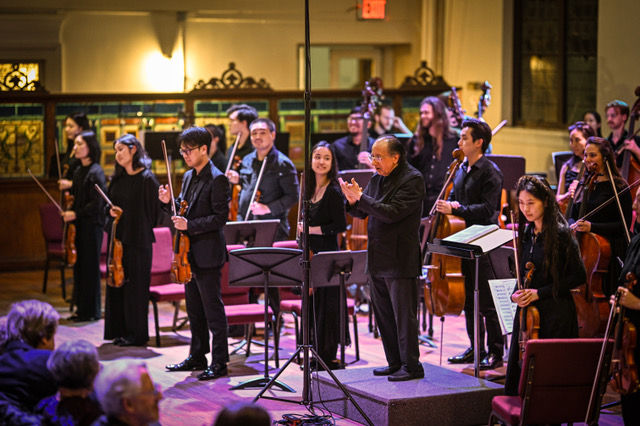
The newly formed WA Sinfonietta, under the baton of the world-renowned clarinetist Charles Neidich, gave its second-ever performance on May 13th at the DiMenna Center for Classical Music, with works by Gideon Klein, Galina Ustvolskaya, and Mieczysław Weinberg. The inaugural concert on March 23rd of this year had already shown the potential and polish of this ensemble. (Interested readers can click on the following link to read about that concert, and also get background information about the organization and the founding as well: WA Sinfonietta in Review March 23, 2025.) This concert was dedicated to the memory of Joel Krosnick, whom Mr. Neidich called “a musician’s musician.”

As Mr. Neidich stated, the ”common bond” of the three composers featured tonight – Weinberg, Klein, and Ustvolskaya – is that all were born in the year 1919. I almost half-expected Shostakovich’s  Suite from The Unforgettable Year 1919 to make a guest appearance, but that little joke would have been a bit out of place given the serious tone of this concert.

In contrast to the inaugural concert, there were printed program notes here. Mr. Neidich did speak about each work as well, but his is a voice that is good for close conversations, not for a hall. I did hear an audience member say that he needed a mic, and I had thought the same. He has so much to say that is informative and interesting that it is a shame for the audience members to miss even a single word.

Divertimento, by Gideon Klein (1919-1945), opened the concert. Klein, like Victor Ullmann amongst others, was another remarkable talent who was snuffed out in the Holocaust. One can only imagine what great works he would have created if he had lived – as this work, finished at age twenty, is remarkably mature for such a young composer. This four-movement work is scored for two oboes (Myles Meader, Aaron Haettenschwiller), two clarinets ( Andrei Caval, Chad Thomas), two bassoons (Christian Whitacre, Austin Wegener), and two horns (Franco Ortiz, Mychal Nishimura). Divertimento is brimming with an almost cartoon-like frenetic energy, but also has some rather pessimistic moments that almost border on despair. Mr. Neidich led this octet in a highly polished reading. That cartoon-like energy was never rendered as “cartoonish” noises, but it is rather sophisticated music that might have very well been used by Carl Stalling if he had been aware of it. The third movement Adagio, using material based on Janáček’s The Diary of One Who Disappeared, was  especially potent, and was played with an anguished urgency. As much as I enjoyed the frenzy of the other movements, this was the highlight for this listener.

I’m also going to group the two Weinberg works together, even though they were not played consecutively, so we’ll continue with the piece by Galina Ustvolskaya (1919-2006). (The Klein and Ustvolskaya pieces were chamber works and were not played by the Sinfonietta Strings but by invited winds and pianist.) Ustvolskaya is aptly described in the program notes as “one of the most original and uncompromising composers of modern times.” Considered by Shostakovich to be his most talented student, Ustvolskaya was later to reject any connection with him, and called his music “dry and lifeless.” She left only twenty-one compositions that she approved of as her legacy – the remainder were destroyed or disavowed.

Mr. Neidich spoke about the triptych of her Compositions 1, 2, and 3, and the unusual scoring for each – Composition No. 1,  Dona Nobis Pacem, for piccolo, tuba and piano,  Composition No. 2, Dies Irae, for eight double basses, piano and wooden cube, and Composition No. 3, Benedictus, Qui Venit, four flutes, four bassoons and piano. It was the last of the three that we heard this evening, with flutists Arianna Bendit, Ji Young Kim, Yidi Wang, Wen-Hsin Weng, bassoonists Trey Coudret, Austin Wegener, Chrisitan Whitacre, Nadia Ingalls, and pianist León Bersdorf. In this work one can readily see why she was called “The Lady with the Hammer.” It is insistent and acerbic, and while it seems there is just a motive repeated over and over, there is a discernible arc that forms the work. While the music itself is rather simple (mostly quarter notes and clusters in the piano) it is deceptively difficult for all nine players to mesh together well. These nine players did just that, and expertly so in a nuanced performance. It’s not a crowd-pleaser for sure, but one got the distinct impression that the audience found it thought-provoking.

Mieczysław Weinberg (1919-1996) is a composer who, after years of neglect, is starting to regain attention and favor with performers and audiences alike. Mr. Neidich informed the audience that during his time in the Soviet Union he had been completely unaware of Weinberg’s existence, which is extraordinary given Mr. Neidich’s relationships with many lesser-known Soviet composers and musicians – one would have thought that a composer as prolific as Weinberg might have come up in conversation.

The Concerto for Clarinet and String Orchestra, Op. 104, was the first of the two Weinberg works. If one had not known any better, one might have thought that this concerto was written especially for Mr. Neidich. It is packed with virtuoso passagework, soaring melodies that require exquisite tonal control, full use of the entirety of the clarinet’s extensive range, and wide-ranging mood shifts – all things that Mr. Neidich excels at in spades. The opening is unsettled and almost angry, with chattering call-and-reply between the clarinet and the orchestra, with increasing stridency. The second movement is melancholic, but the clarinet takes a lovely melody and pushes it through the clouds into a burst of sunshine. The final movement is a merry dance, but in the merriment there are hints of sorrow that hover over it. Mr. Neidich gave a superb performance of it all, turning over the conducting duties to a very able conductor whose name was unfortunately not mentioned in the program. Mr. Neidich was in top form – the cadenza work was especially notable for not only its virtuosity, but for the crystalline clarity with which Mr. Neidich delineated each note at lightning speed.

The Weinberg Chamber Symphony No. 4, Op. 153, was the final work of the evening. Mr. Neidich stated that this was the composer’s final work (there is an Op. 154, the 22nd Symphony, which was orchestrated by Kirill Umansky in 2003, so perhaps the Op. 153 was the final work solely by Weinberg). There are four movements played without pause. Four triangle strokes feature in it prominently, each as an “announcement,” but what exactly Weinberg meant by these triangle strokes is open for speculation. Mr. Neidich opined that the final triangle stroke was Weinberg’s declaration that “humanity can be wonderful,” but this listener would equate it to the last measures of Mahler’s 9th Symphony – a good-bye to life itself. While it is not called a concerto, it is a clarinet concerto in all but name, given the leading role the clarinet plays and the absence of any other wind instruments.

The opening is a chorale that uses a theme Weinberg had used three times previously (Opp. 110. 127, and 128). The clarinet soon joins and has a dialogue with the orchestra, then the mood shifts to one of terror. The first triangle stroke signals the beginning of the final section, the next two call forth a Klezmer tune, and the last signals the end. The WA Sinfonietta was outstanding in projecting the mood with crisp ensemble playing and never overshadowing the clarinet soloist. As for Mr. Neidich, what more can one say? He is so incredibly precise that any clarinet hopefuls would be well-advised to seek him out and learn from him, not only his technique, but his musicianship and his scholarly mien. It was spellbinding and the audience gave him an extended and well-deserved standing ovation. It is also wonderful to see how much joy Mr. Neidich has and how he shared that joy with all the musicians that performed with ebullient handshakes for all. I look forward to the next WA Sinfonietta concert.


FacebookTwitterLinkedInRedditEmail

by Jeffrey Williams for New York Concert Review; New York, NY

IMG_7287.jpg
Screenshot 2025-09-23 at 9.52.11 AM.png

WA Concert Series Presents “The World of the Expanded Clarinet” in Review

Charles Neidich, clarinet; Ayako Oshima, clarinet

Michael Lowenstern, bass clarinet; Mohamed Shams, piano

Tenri Cultural Institute, New York, NY

March 1, 2024

The Tenri Cultural Institute was packed this Friday as the WA Concert Series presented a “re-debut” program entitled “The World of the Expanded Clarinet” led by WA co-founders Charles Neidich and Ayako Oshima. It reminded us of how much we’ve been missing since March of 2020, when the onslaught of COVID-19 forced their hiatus (apart from some virtual offerings). I am happy to report that they are back and better than ever!

WA concerts have always been known for their fascinating, sometimes eclectic, programs, performed by dazzling musicians, with clarinetists Charles Neidich and Ayako Oshima (Mr. Neidich’s wife and partner) at the helm. Your reviewer (along with most of the music world) has admired the virtuoso playing of Charles Neidich for over four decades now (his biography being too crammed with honors and distinctions to relay but found here: Charles Neidich), and the brilliant Ayako Oshima has established herself as a formidable force in her own right – but Friday’s “dream team” was made still stronger with the inclusion of rock-solid pianist Mohamed Shams and ingenious bass clarinetist Michael Lowenstern.

The program incorporated old and new, including well-known nineteenth-century music by César Franck and Ernest Chausson and twentieth-century works of Nadia Boulanger (1887-1979), Yayoi Kitazume (b. 1945), and Edison Denisov (1929-1996), plus compositions by Mr. Lowenstern (b. 1968) and Mr. Neidich (b. 1953).

The evening started with Trois Pièces by Nadia Boulanger, a set originally composed for organ in 1911, arranged by the composer in 1914 for cello and piano, and transcribed for clarinet “last week” by Mr. Neidich, as he announced much to the amusement of the audience. The opening Moderato was a perfect welcome to the concert, with its dreamy clarinet lines floating over quasi-impressionistic piano accompaniment. The second piece, Sans vitesse et à l’aise,brought to mind the restrained sorrow of some of Ravel’s more solemn works and was delivered with eloquence. In both of these pieces, the clarinet handled the original cello lines with equivalent or heightened lyricism, sacrificing nothing, while in the third and final piece, Vite et nerveusement rythmé, the clarinet seemed actually to add a spiky precision to the work’s frenetic energy. Bravo to this wonderful addition to the clarinet transcription literature!

Ayako Oshima took the stage next to perform the U.S. premiere of a 2017 work by Yayoi Kitazume with its title translated from the Japanese as “Teetering Balance” and based on the Paul Klee painting of a similar title, usually referred to as “Unstable Equilibrium” (1922, watercolor over pencil). Until Ms. Oshima pointed it out, this listener was unaware that there were program notes (accessible by a QR code in the printed program), including a reprint of the Paul Klee artwork, so not having been able to envision the artwork before hearing it made listening an even more interesting experiment. There was only the music as a guide in what seemed a fascinating exploration of musical space. Upon later reading in Ms. Kitazume’s notes that she “wanted to construct a three-dimensional piece of music that blended time frames and directions of consciousness” the work and performance seemed in retrospect even more remarkably on target. Ms. Oshima painted with her clarinet a picture so vivid that most visual artists would be envious. It was a highlight of the concert.

1f01073e57f32f698f3a1175ea84c64a.JPG
bottom of page